DocTIS presents single-cell research on therapeutic response in IMIDs at ISCO 2026
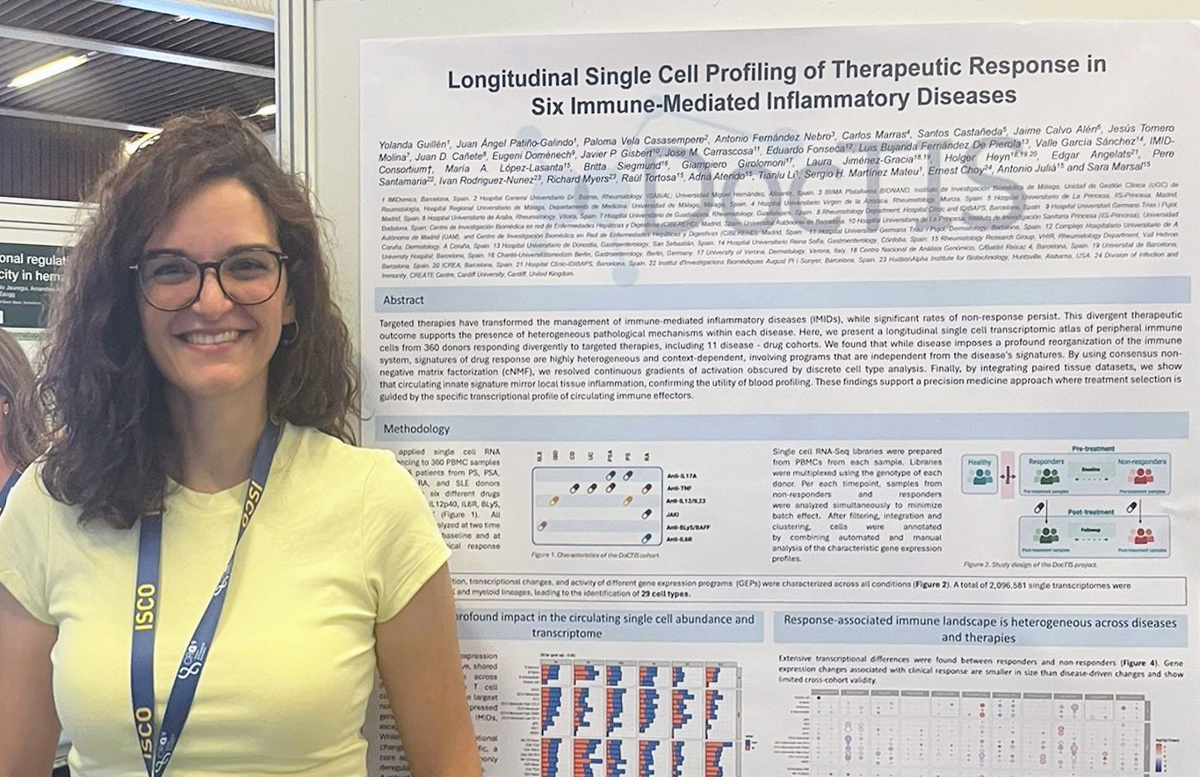
Latest findings from the DocTIS project were presented at the Innovations in Single Cell Omics conference (ISCO 2026), bringing novel insights into the biological mechanisms underlying treatment response in immune-mediated inflammatory diseases (IMIDs).
Dr. Yolanda Guillén, Bioinformatics Scientist at IMIDomics and member of the DocTIS team, presented the poster “Longitudinal single-cell profiling of therapeutic response in six immune-mediated inflammatory diseases”, showcasing results obtained from the single-cell datasets generated within the project.
A large-scale single-cell atlas of therapeutic response
The study analyses peripheral immune cells from 360 samples across eleven different IMID cohorts, encompassing six IMIDs and five drugs, creating a longitudinal single-cell transcriptomic atlas of therapeutic response. By examining patients with divergent responses to targeted therapies, the research aims to better understand why some individuals benefit from treatment while others do not.
The results show that although disease itself causes major alterations in the immune system, treatment response is highly heterogeneous and depends on biological mechanisms that are not necessarily linked to the disease signatures, traditionally used to classify patients. The work also demonstrates how advanced computational approaches can identify subtle immune activation programmes that remain hidden using conventional analyses.
In addition, by integrating blood and tissue datasets, the study identified circulating immune signatures that mirror local tissue inflammation in rheumatoid arthritis (RA) and Crohn’s disease (CD), supporting the potential of blood-based molecular profiling as a less invasive approach for monitoring disease activity and guiding treatment decisions.
Standing out in a cancer-focused programme
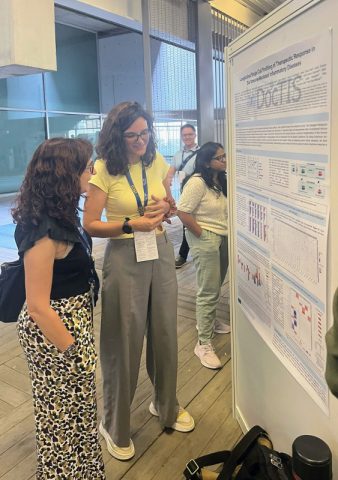
The poster was presented during the conference’s dedicated poster session, where it attracted considerable interest from attendees.
“Several people were interested in the work, particularly because of the number of samples collected throughout the project”, said Guillén.
The dataset attracted attention due to its scale and because it represented one of the few contributions focused on autoimmune diseases in a programme largely dominated by cancer research.
“Most of the presentations focused on immune cell differentiation dynamics and cancer. Out of all the posters, only ours and one other addressed autoimmune diseases, allowing our project to stand out”, she added
According to Dr. Guillén, the conference also provided a valuable overview of current developments in the single-cell field, including the newest experimental technologies and computational methods for analysing increasingly complex biological datasets.
ISCO has established itself as a specialised international meeting dedicated to single-cell and spatial omics technologies. The 2026 edition brought together around 150 researchers from leading academic and biomedical institutions to discuss recent advances in areas such as cellular perturbations, lineage tracing, epigenomics and translational applications of omics approaches.
The findings presented at ISCO 2026 contribute directly to DocTIS efforts to better understand the biological basis of treatment response across rheumatoid arthritis, psoriatic arthritis, psoriasis, ulcerative colitis, Crohn’s disease and systemic lupus erythematosus. By identifying molecular programmes associated with therapeutic outcomes, the project aims to support more precise treatment selection and the development of effective combinatorial therapies.
DocTIS is coordinated by the Vall d’Hebron Research Institute, VHIR (Sara Marsal) and brings together Cardiff University (Ernest Choy), the University of Verona (Giampiero Girolomoni), Charité – Universitätsmedizin Berlin (Britta Siegmund), the Institut d’Investigacions Biomèdiques August Pi i Sunyer, IDIBAPS (Pere Santamaria), the National Center for Genomic Analysis, CNAG (Holger Heyn), IMIDomics Inc. (Manuel Lopez-Figueroa), HudsonAlpha Institute for Biotechnology (Richard M. Myers) and Zabala Innovation.