Myrsini Gianatsi: “Reducing the time patients spend on ineffective treatments can have a real impact on their quality of life”
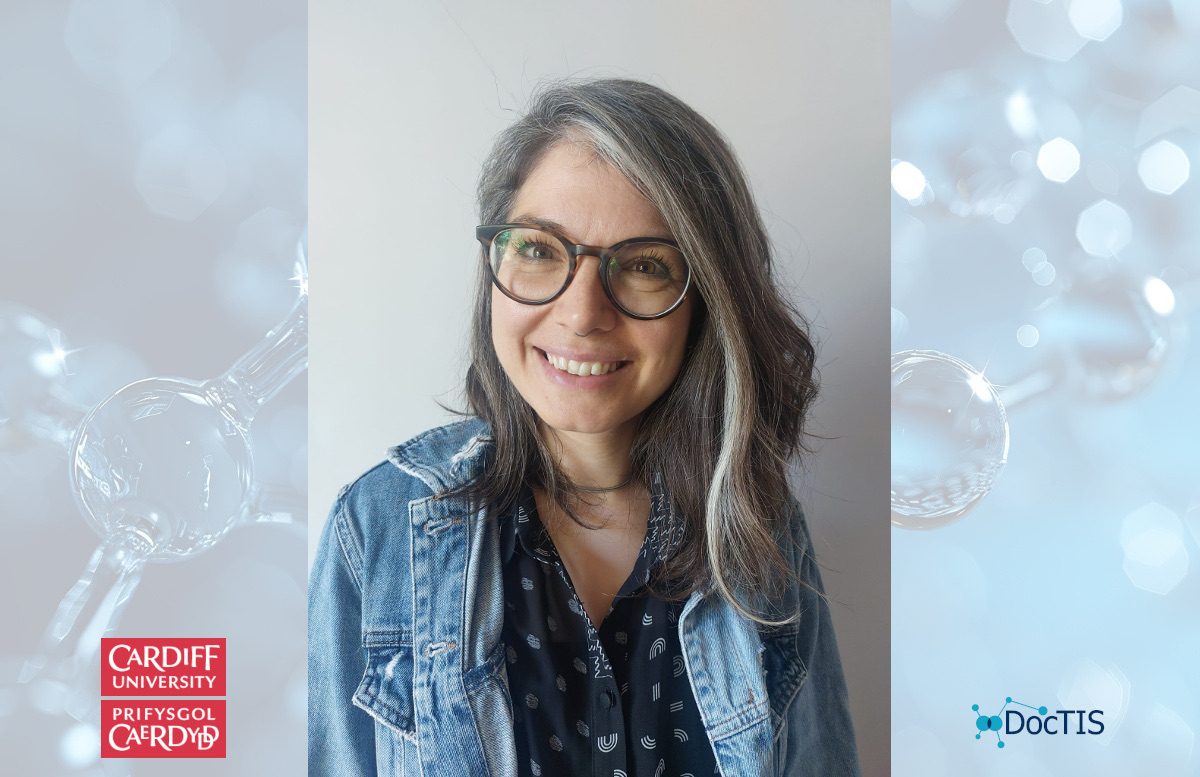
Understanding how to design and analyse complex clinical trials is essential to advancing more effective treatments for immune-mediated inflammatory diseases. In DocTIS, this challenge is addressed through innovative trial methodologies that aim to evaluate new therapeutic strategies more efficiently across different patient groups.
Cardiff University plays a key role in this effort through its Centre for Trials Research, which leads the clinical trial design and implementation within the project. By combining statistical expertise with clinical insight, the team contributes to ensuring that the study is robust, reliable and capable of generating meaningful evidence to guide future treatment decisions.
In this interview, as part of the DocTIS series highlighting early-career researchers, we speak with Myrsini Gianatsi, medical statistician at Cardiff University, who works on the statistical design and analysis of the clinical trial.
Hi, Myrsini. Please tell us about yourself.
Hi! I am a medical statistician based in the UK, working for the Centre for Trials Research at Cardiff University. My background is in statistics. I did my BSc in Statistics and Insurance Science at the University of Piraeus in Greece, then moved to the UK for an MSc in Medical Statistics at Lancaster University.
I have been doing research ever since, working across mental health, epilepsy, and now clinical trials. I recently completed my PhD at the University of Liverpool, which focused on network meta-analysis of anti-seizure medications for drug-resistant focal epilepsy.
My interest in immune-mediated inflammatory diseases grew through my work at Cardiff. I came into the field through statistics rather than biology, but I have found it genuinely fascinating territory, particularly because these are conditions where patients often struggle for years to find effective treatments.
How did you become involved in the DocTIS project?
I was already working at the Centre for Trials Research when DocTIS came along, and I was brought onto the project as part of the statistical team. What drew me most to DocTIS was its ambition. It is not a standard two-arm trial.
The basket design, the combination therapy approach, and the Bayesian methods being used are exactly the kind of methodological challenges that I find motivating.
What is your role within DocTIS?
My role is on the statistical side of the trial. I contribute to the statistical analysis plan, which sets out in advance exactly how we will analyse the results, and I work closely with the clinical and data teams to ensure the analysis is fit for purpose.
A significant part of our work involves developing the statistical methods that will be used to analyse the trial outcomes across both the rheumatoid arthritis (RA) and psoriatic arthritis (PsA) arms. The design of DocTIS also allows information to be “borrowed” across arms (meaning that results from one group can help inform the analysis of the other), and getting that methodology right is essential for the credibility of the results.
How would you explain your research in DocTIS to someone outside science?
DocTIS is testing whether switching to a different type of drug, one that targets another part of the immune system, can help patients with rheumatoid arthritis or psoriatic arthritis who have not responded well enough to their current medication.
My role is to ensure that the data from the trial are analysed in a way that provides a reliable answer. What makes DocTIS unusual is that it studies this question in two related conditions at the same time, using methods that allow us to learn from both groups together rather than treating them as completely separate experiments. This makes the trial more efficient and potentially more informative.
What do you find most innovative about the DocTIS approach?
For me, the most innovative aspect is the statistical methodology underpinning the design. The use of Bayesian hierarchical models (which allow information to be shared across patient groups) to borrow information across the RA and PsA arms is not something that has been widely applied in this field.
Developing and implementing this approach in a way that is scientifically rigorous and transparent for regulators and clinicians is genuinely novel. The European collaboration is also important, as it brings together patient populations and expertise that no single centre could achieve alone.
What has been your biggest challenge so far?
The methodological complexity has been the main challenge, particularly because adaptive designs require careful planning and validation.
I have also found the volume and complexity of the data to be a practical challenge. Preparing the data for analysis is not always visible work, but it is essential. I am genuinely grateful to the data management team for creating and maintaining the dataset, as none of the statistical work would be possible without that foundation.
What achievement within DocTIS has been most satisfying for you?
Working with the senior statistician and the rest of the team to bring the statistical analysis plan to a stage where the methodology is clearly specified and agreed upon has been a major milestone.
These plans go through multiple iterations and reviews, so reaching a version that captures the complexity of the design is something I am genuinely proud of. Getting the methodology right at this stage is critical for protecting the integrity of the analysis once the trial is completed.
What does it mean for you, as an early-career researcher, to see your work potentially translated into clinical trials or patient care?
It matters a lot. Much of my previous work, such as network meta-analyses and systematic reviews, was several steps removed from direct patient impact.
In DocTIS, the analysis we are doing will directly inform whether patients gain access to new treatment options. I feel very lucky that I am a part of this trial and team.
How has working in a European consortium influenced your development as a researcher?
Working in a consortium like DocTIS has pushed me to communicate more clearly across a team with very diverse expertise, which I think is one of the most valuable skills in research.
It has also shown me how important collaboration is. When everyone understands their role and works effectively together, the different parts of a trial come together in a way that would not be possible in isolation. It has been very insightful to see how each contribution fits into the overall project.
How do you think DocTIS could impact patients in the future?
If the trial shows that switching to an IL-6 inhibitor improves outcomes for patients who have not responded adequately to TNF inhibitors, it could provide clinicians with a clearer treatment pathway.
For conditions such as rheumatoid arthritis and psoriatic arthritis, reducing the time patients spend on ineffective treatments can have a significant impact on their quality of life.
What key lessons have you learned from being part of DocTIS?
Scientifically, I have learned a great deal about adaptive trial design and Bayesian methods in a real-world setting. Seeing how these approaches behave with actual data has been invaluable.
On a personal level, I have learned that being clear about uncertainty and acknowledging what you do not know is not a weakness, but an important part of doing good research.
Where do you see your research career heading in the future?
I would like to continue working as a statistician in clinical trials and to keep learning from collaboration with other statisticians.
DocTIS has strengthened my interest in adaptive designs, and I would like to develop this expertise further by contributing to similar trials in the future. I am also interested in the use of large healthcare datasets and how they can complement trial data.
If you were not working in research, what career path do you think you would pursue?
If I were not working in research, I think I would still be drawn to something involving data or evidence, perhaps in policy or industry.
But if I had to choose something completely different, I would love to run a bookshop. I would make sure there was a special section dedicated to statistics and science books written for general audiences, the kind that make complex ideas accessible and spark curiosity in people who might never have considered themselves ‘numbers people.’ I think there is something wonderful about the idea of bringing those two passions together.
By combining innovative trial design with rigorous analysis, DocTIS is contributing to more efficient and informative clinical studies, ultimately supporting better therapeutic strategies for patients with immune-mediated inflammatory diseases.
Coordinated by the Vall d’Hebron Research Institute, VHIR (Sara Marsal), the project brings together Cardiff University (Ernest Choy), the University of Verona (Giampiero Girolomoni), Charité – Universitätsmedizin Berlin (Britta Siegmund), the Institut d’Investigacions Biomèdiques August Pi i Sunyer, IDIBAPS (Pere Santamaria), the National Center for Genomic Analysis, CNAG (Holger Heyn), IMIDomics Inc. (Manuel Lopez-Figueroa), HudsonAlpha Institute for Biotechnology (Richard M. Myers) and Zabala Innovation.