Edgar Angelats: “Many patients with IMIDs do not respond to current therapies and need better solutions”
A key step in the DocTIS project is ensuring that therapeutic strategies identified through data-driven approaches can be translated into real biological effects. Before moving towards clinical application, these strategies must be tested in experimental models to assess both their efficacy and safety.
Within this framework, the Institut d’Investigacions Biomèdiques August Pi i Sunyer (IDIBAPS) is one of the core partners responsible for the preclinical validation of combinatorial therapies. This work includes evaluating selected drug combinations across a broad portfolio of autoimmune and inflammatory disease models, helping to confirm whether the proposed strategies can deliver meaningful results in vivo.
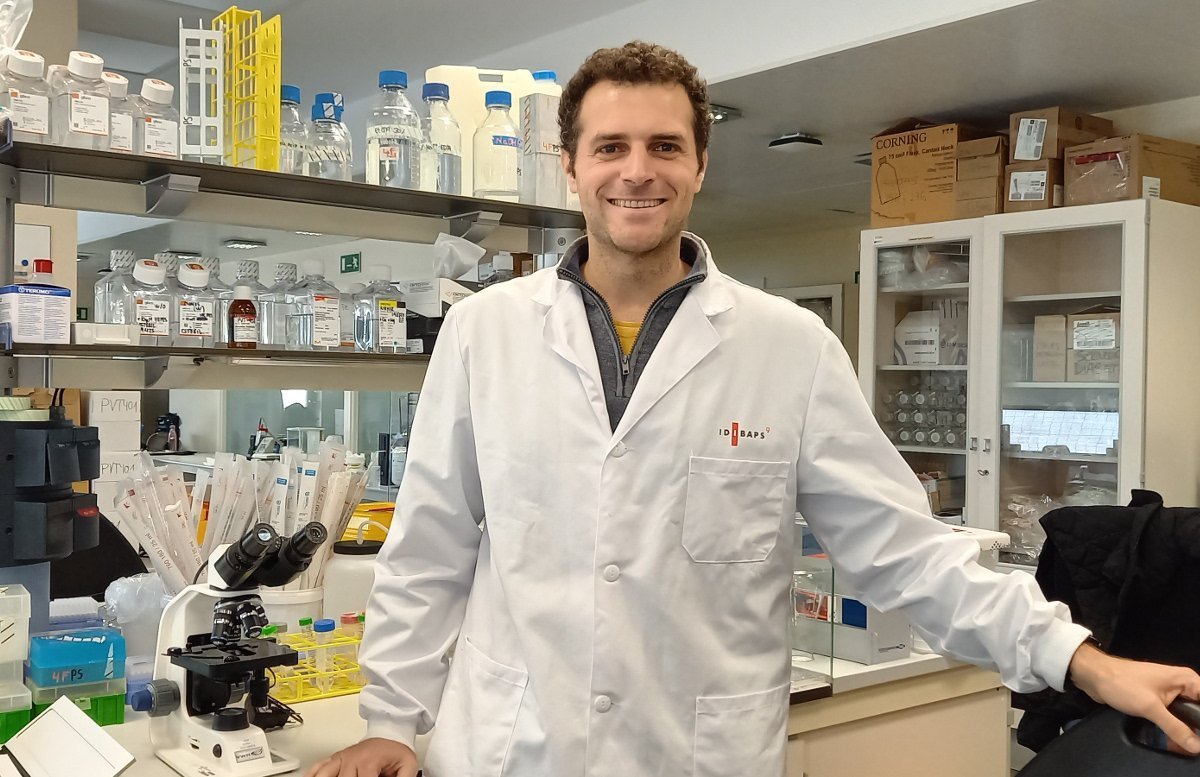
In this interview, part of a series featuring young researchers involved in DocTIS, we speak with Edgar Angelats, Postdoctoral Scientist at IDIBAPS, who contributes to the project by developing and analysing preclinical models to validate therapeutic approaches, under the leadership of Dr. Pere Santamaria.
Hola, Edgar. Please tell us about yourself.
Hola! I am a Postdoctoral Scientist in the Pathogeny and Treatment of Autoimmunity Laboratory at IDIBAPS in Barcelona.
I studied Biomedical Sciences and later completed a Master’s degree in Neuroscience at the University of Barcelona, where I also carried out my PhD in Biomedicine. After that, I moved to Brussels to work at the Institute for Interdisciplinary Research in Human and Molecular Biology at the Free University of Brussels, where I started working with rodent models and immunology.
Among the different projects I worked on there, one focused on uveitis, which gave me my first exposure to autoimmune diseases and IMIDs. Later, I had the opportunity to join the Pathogeny and Treatment of Autoimmunity group at IDIBAPS.
How did you become involved in the DocTIS project?
I was hired at IDIBAPS specifically to work on the DocTIS project.
At that point in my career, I was already interested in moving from basic research towards a more translational approach, aiming to have a more direct impact on patients’ lives. This was one of the main reasons that attracted me to the project.
At the same time, after COVID-19, I was also considering returning to Barcelona, so everything aligned: joining a group focused on translational science and coming back home.
What is your role within DocTIS?
Within DocTIS, I am responsible for the different preclinical models and the experiments associated with them, including techniques such as histopathological analysis.
Our work aims to validate, in vivo, the results generated by other work packages through systems biology approaches. In this way, we help confirm whether the proposed drug combinations are effective and support the use of these strategies to identify the best treatments for patients.
How would you explain your research in DocTIS to someone outside science?
First, I would explain why this work is important. Many patients with immune-mediated inflammatory diseases do not respond to current therapies, so there is a need for new and more effective solutions.
Then, I would describe the main goal of DocTIS: identifying new combinations of already approved drugs using advanced technologies such as systems biology. The idea is to find better therapeutic strategies that can lead to more personalised treatments.
Finally, I would explain my role, which is to test these combinations in animal models to make sure they actually work before moving forward.
What do you find most innovative about the DocTIS approach?
If I had to choose one element, I would highlight the systems biology strategy. However, I believe that what really makes DocTIS innovative is the integration of all its components.
Each work package on its own is interesting, but it is the combination of all of them that creates real impact. Without this integration, the project would not be as powerful in terms of its potential to benefit patients.
What has been your biggest challenge so far?
One of the biggest challenges has been generating transcriptomic data from murine tissues.
These experiments require a lot of optimisation, especially when starting from scratch. Even when protocols seem ready, working with inflamed tissues adds an additional level of complexity, as they are much more sensitive. This was particularly challenging in some of our models, such as those involving intestinal tissue.
What achievement within DocTIS has been most satisfying for you?
It has been very satisfying to see that, in the rheumatoid arthritis model, our experimental results are consistent with the predictions from systems biology analyses.
This gives us confidence that the overall approach is working as expected. In a way, our preclinical data act as an internal validation of the project. Hopefully, these results will also be reflected in the clinical trial.
What does it mean for you, as an early-career researcher, to see your work potentially translated into clinical trials or patient care?
Before joining DocTIS, I was already interested in moving towards more translational research.
Being part of a project where our work can potentially impact patients’ lives is very rewarding. I would be especially satisfied if the strategy of identifying drug combinations could eventually be implemented in clinical practice, even for patients who currently do not respond to existing therapies.
This experience has confirmed that moving towards a more translational path was the right decision for my career.
How has working in a European consortium influenced your development as a researcher?
Our work in preclinical models is somewhat different from other work packages, so we do not interact as closely on a daily basis.
However, being part of DocTIS has contributed significantly to my development. I have gained experience with new experimental models and techniques, and I have also had the opportunity to present our work and receive feedback from other researchers.
In addition, following the work of other partners has allowed me to learn about different areas and perspectives, which has been very enriching. Overall, I feel that I am a better researcher now than when I started.
How do you think DocTIS could impact patients in the future?
I think DocTIS could provide clinicians with new tools to treat patients who currently have limited therapeutic options.
By enabling more personalised treatment strategies, the project could improve treatment outcomes and reduce side effects. In the long term, this could also have a positive impact on healthcare systems by improving disease management.
What key lessons have you learned from being part of DocTIS?
It is difficult to highlight just one lesson, as I have learned a lot throughout the project.
Beyond technical skills and protocols, I have gained a broader scientific perspective and a better understanding of collaboration across different types of partners, including research groups and companies working towards a common goal.
Where do you see your research career heading in the future?
At this point, it is difficult to predict where I will be in ten years. However, this project has confirmed that working in translational research is the right path for me.
I would like to continue working on projects like this, while continuing to learn and develop as a scientist.
If you were not working in research, what career path do you think you would pursue?
It is difficult to say, as I have always seen myself working in science.
If I had chosen a different path, it would probably have been related to sports. I am very passionate about sports, especially team sports, so I imagine I would have pursued something in that field.
Edgar’s work highlights the importance of preclinical validation in ensuring that scientific discoveries can move towards real clinical applications.
By testing therapeutic strategies in experimental models, DocTIS strengthens the link between computational predictions and patient care, helping to ensure that proposed treatments are both effective and safe.
Coordinated by the Vall d’Hebron Research Institute, VHIR (Sara Marsal), the project brings together Cardiff University (Ernest Choy), the University of Verona (Giampiero Girolomoni), Charité – Universitätsmedizin Berlin (Britta Siegmund), the Institut d’Investigacions Biomèdiques August Pi i Sunyer, IDIBAPS (Pere Santamaria), the National Center for Genomic Analysis, CNAG (Holger Heyn), IMIDomics Inc. (Manuel Lopez-Figueroa), HudsonAlpha Institute for Biotechnology (Richard M. Myers) and Zabala Innovation.