Sergio Martínez: “Combining existing drugs could impact clinical practice much faster than developing new therapies”
Understanding and improving treatment strategies for immune-mediated inflammatory diseases (IMIDs) requires a deeper understanding of disease mechanisms and patient responses to therapies. DocTIS focuses on conditions such as rheumatoid arthritis, psoriatic arthritis, psoriasis, ulcerative colitis, Crohn’s disease and systemic lupus erythematosus, combining advanced computational approaches with clinical and molecular data to capture this complexity and identify optimal combinations of existing therapies that can improve treatment response and long-term disease control.
Within this data-driven framework, IMIDomics Inc. plays a central role in the project, leading the integration of high-throughput clinical and molecular data, contributing to the development of predictive biomarkers, and supporting the translation of research findings into potential therapeutic strategies.
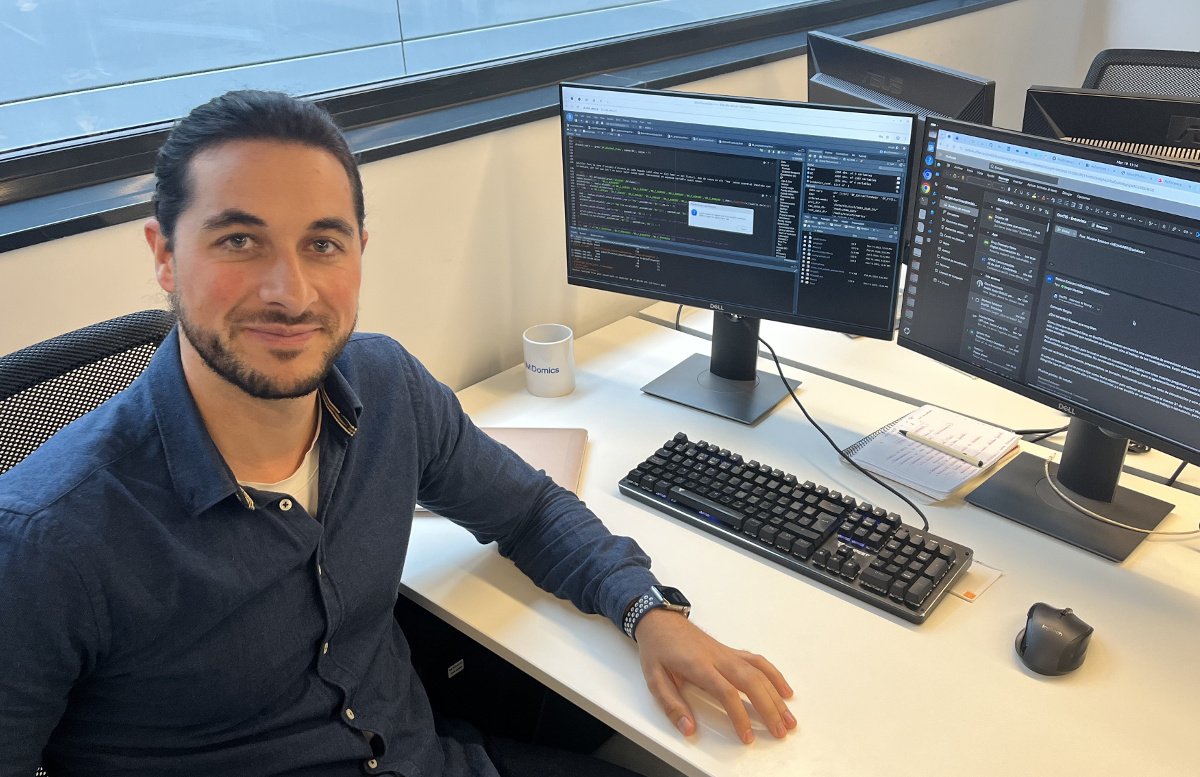
As part of a series of interviews with young researchers involved in DocTIS, we speak with Sergio Martínez, machine learning scientist at IMIDomics, who contributes to the project through bioinformatics and data analysis aimed at identifying optimal drug combinations.
Hola, Sergio. Please tell us about yourself.
Hola! I am Sergio Martínez, and I work at IMIDomics Inc. as a machine learning scientist, based in Barcelona.
I started my career studying Mathematics and Physics, but I soon became interested in applied statistics and realised that biomedical research was one of the most interesting and impactful fields I could work in.
I had the opportunity to join IMIDomics in its early stages, as a spin-off of the Rheumatology Research Group at Vall d’Hebron Hospital, and I have been working here full-time since then. Over the years, I have continued to develop my profile as a biostatistician and bioinformatician, specialising in areas such as multi-omics integration and Mendelian randomisation.
How did you become involved in the DocTIS project?
I became involved in DocTIS as part of the bioinformatics team at IMIDomics. Our team contributed to several work packages within the project, mainly related to data analysis.
What is your role within DocTIS?
I was involved in several stages of the project. First, I performed the selection of the samples to be sequenced in close collaboration with the clinical experts of the DocTIS project. Applying the right criteria and iterating closely with clinicians was key to optimizing the statistical properties of the study design.
Later, I worked on the quality control of the bulk transcriptomics data and subsequently participated in the main analysis, with the objective of prioritizing potential drug combinations. I consider this part of the work to be one of the most challenging and innovative aspects of the project. We developed several methods to systematically evaluate all potential combinations and generate meaningful results aligned with the main objectives of the project.
I contributed a wide range of ideas, some inspired by the literature and others driven by deep, problem-focused thinking. It was one of the most creative tasks I have undertaken as a scientist. The entire process was very enjoyable, but it became particularly compelling when we observed that the results were converging in a clear direction, were across omics layers and were in agreement with findings from animal models.
How would you explain your research in DocTIS to someone outside science?
The main goal of DocTIS is quite straightforward: to improve treatment options for patients with autoimmune diseases.
Although these diseases already have more specific treatments than in the past, there is still room for improvement. One approach is to develop completely new drugs, which is something pharmaceutical companies are already working on.
What we are trying to do is different. We are exploring whether combining existing drugs could lead to better results. Since these drugs act through different mechanisms, they may complement each other.
An additional advantage is that these drugs are already known to be safe and effective, which means that this strategy could reach clinical practice much faster than developing new therapies from scratch.
What do you find most innovative about the DocTIS approach?
For me, the most innovative aspect is the study design. We are using longitudinal data from both responders and non-responders to treatments, and we are generating multiple layers of molecular data from the same patients, including both bulk and single-cell transcriptomics.
This type of integrated approach provides a much more complete picture of how patients respond to treatment.
What has been your biggest challenge so far?
One of the biggest challenges has been the lack of existing methods for this type of analysis. Since the project is quite innovative, there were no established approaches to prioritise drug combinations using this kind of data.
This meant that we had to develop new methodologies from scratch.
What achievement within DocTIS has been most satisfying for you?
One of the most satisfying achievements has been identifying a clear candidate for an optimal drug combination after systematically evaluating all possible options.
What does it mean for you, as an early-career researcher, to see your work potentially translated into clinical trials or patient care?
It is one of the most exciting aspects of my work as a scientist.
The possibility of having a real impact on patients’ lives in the short term is what initially attracted me to biomedical research, and DocTIS is a very clear example of that.
How has working in a European consortium influenced your development as a researcher?
The consortium includes top-level scientists from different disciplines, and being able to work with them has been a very valuable experience.
I have had the opportunity to share ideas, receive feedback and learn from experts in different fields, which has contributed significantly to my development.
How do you think DocTIS could impact patients in the future?
If the drug combination we identified proves to be more effective than current treatments in clinical trials, it could lead to a new therapeutic approach in clinical practice.
This could result in higher efficacy rates or more sustained remission for patients.
What key lessons have you learned from being part of DocTIS?
From a scientific perspective, it has been a continuous learning process. I would highlight gaining a deeper understanding of targeted therapies and how treatment response is measured in patients.
At a broader level, this has been my first experience in a European project of this scale, so I have also learned a lot about how these projects are structured and managed, including work packages, reporting periods and advisory board meetings.
Overall, it has been a very enriching experience.
Where do you see your research career heading in the future?
I would like to continue working in this field and contribute to improving treatment options for patients.
In the long term, I hope to gain enough experience to develop my own ideas and lead impactful projects like DocTIS.
If you were not working in research, what career path do you think you would pursue?
I would probably work as a data scientist in a company. However, if I had to move away from data analysis, I would consider starting my own business.
Through contributions like Sergio’s, DocTIS highlights how advanced data analysis and computational approaches can drive the identification of new therapeutic strategies for patients with immune-mediated inflammatory diseases.
Coordinated by the Vall d’Hebron Research Institute, VHIR (Sara Marsal), DocTIS brings together Cardiff University (Ernest Choy), the University of Verona (Giampiero Girolomoni), Charité – Universitätsmedizin Berlin (Britta Siegmund), the Institut d’Investigacions Biomèdiques August Pi i Sunyer, IDIBAPS (Pere Santamaria), the National Center for Genomic Analysis, CNAG (Holger Heyn), IMIDomics Inc. (Manuel Lopez-Figueroa), HudsonAlpha Institute for Biotechnology (Richard M. Myers) and Zabala Innovation, each contributing their expertise to advance the project’s objectives.